I'll Buy More Oil Stocks When the War Ends
There's never a shortage of oil. Every past oil crisis ended the same way — capacity expanded, prices crashed. This time is different. I'm going to buy more oil stocks, not fewer.

Trump is posting celebrations out of the White House this week: tankers from everywhere are steaming toward the U.S., crude exports hit an all-time high. NASDAQ is partying too. Front-month crude has only just cracked $100; the back of the curve still sits in the low $70s — the market is trading a soft landing.
Wall Street’s call is clean: this is a 2022-style short-term shock, Russia–Ukraine redux. Lift the blockade, supply comes back, crude falls to the pre-war $65.
That’s what history says. Brent ripped to $139 during Russia–Ukraine, then ground all the way back to $65. 2008: $147 back to $30. For four decades almost every oil crisis has run the same script — OPEC spare capacity comes online on cue, demand destruction cycles through, supply shock = short-term trade.
This time is different.
My call: crude never trades below $80 again. The era of cheap fossil energy is over.
The Market Is Still Trading a Fantasy
Start with an optimistic-to-the-point-of-impossible scenario: it’s early May, Iran suddenly surrenders, the U.S. lifts the blockade. (The first three essays argued why this can’t happen. But let’s show just how wrong the market is by pretending it can.)
The June futures could crater to $80 inside a week. The market believes supply snaps back.
But four things actually happen. None of them are priced.
The Ships Aren’t in the Middle East
Pre-war, 138 vessels transited Hormuz daily. It’s 3 now.
Right now, 100+ empty tankers are parked off the U.S. Gulf of Mexico. They were all headed for Hormuz — now they’ve crossed the Pacific to queue for U.S. crude. Loading terminals cap at 5 million barrels/day, a loaded VLCC takes two or three days to fill. Ships at the back of the line wait weeks for a berth. Then another 52 days steaming back across the Pacific to Asia.
For the past six weeks, every large tanker originally bound for Hormuz has diverted to North America. Asia-to-Middle-East one-way is 22 days; Asia-to-U.S.-Gulf one-way is 52 days. 2.3x. The number of loops a single ship can run in a year has just been cut in half — from 8 to 3.5. The global fleet count is fixed. Longer routes = evaporated effective capacity.
And even if Hormuz reopened today, those 100+ in-transit ships don’t turn around — sunk cost is too large. They load at Houston and return to Asia. Houston round-trip is 3+ months. Only then do empty ships head back to the Gulf to load Middle East crude — another 2 months minimum.
That means even if peace arrived yesterday, the earliest Asia sees the next barrel of Persian Gulf crude is 5 months out.
Sal Mercogliano, Campbell University professor of maritime economics: “Even if Hormuz reopens tomorrow, these tankers are all in the wrong place.”
The front-month oil price the market is pricing you right now? It doesn’t contain those 5 months.
Wells Aren’t Faucets
Southern Iraqi oilfields have been shut in for over 7 weeks. Every additional week of shut-in, permanent capacity loss climbs by 2–5 percentage points.
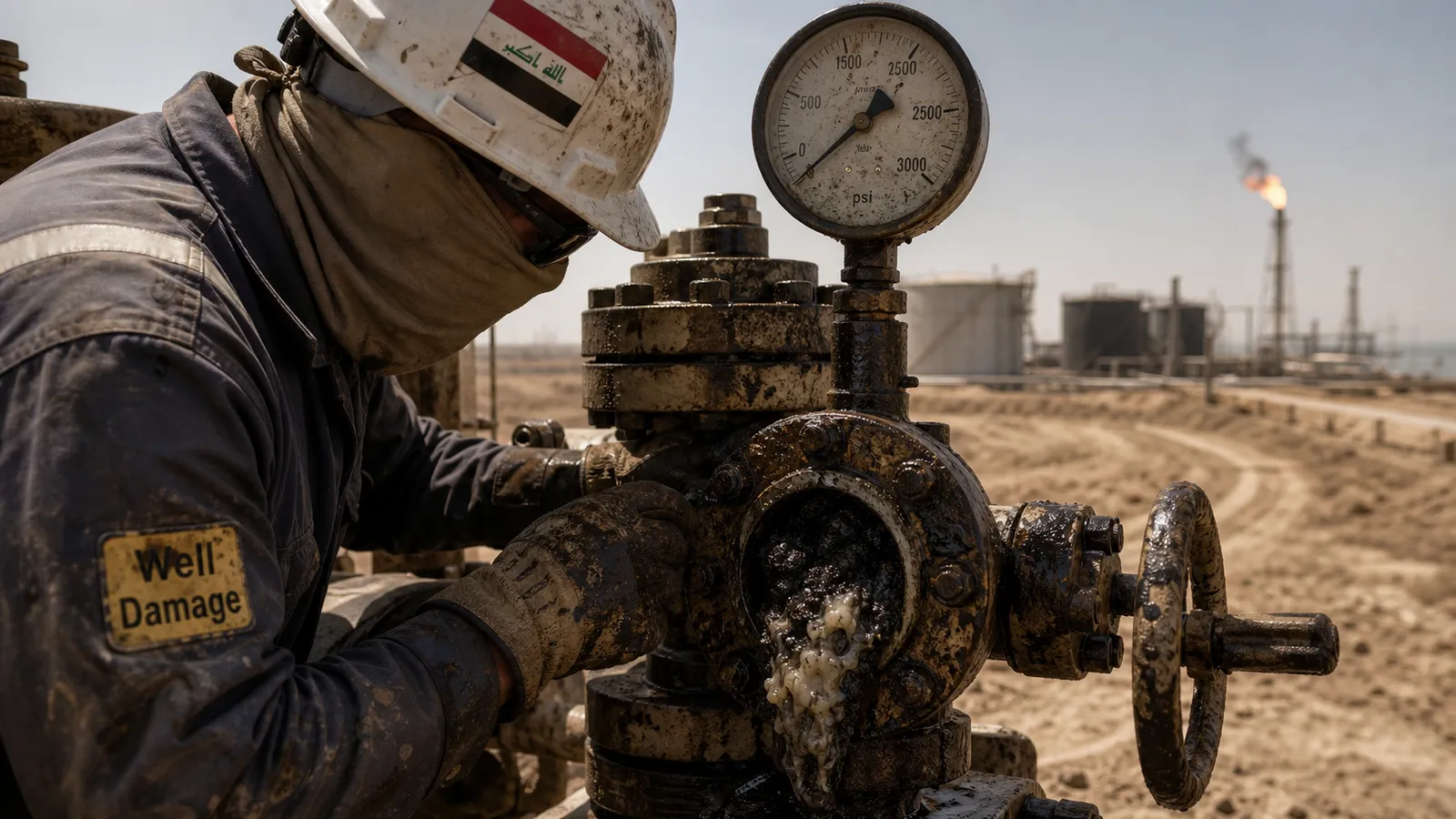
This isn’t a maintenance pause. This is irreversible corrosion.
Oil wells aren’t like kitchen faucets — you can’t close them tight and reopen them to clear water later. Past 4–6 weeks of shut-in, the wellbore starts accumulating wax, pressure drops, condensate damages the reservoir. BP has already publicly stated: they won’t send engineers back until “the war is fully over and the situation is stable” — meaning even after hostilities end, BP still waits months, then spends more months doing well repairs.
Southern Iraq pre-war production: 4.3 million bpd. Currently: 1.3 million. A 70% haircut in one shot. Permanent loss estimated at 20–50%.
Kuwait is more extreme. April exports were zero — the first time since Saddam invaded in 1990.
Add Iraq + Kuwait + Qatar’s two LNG trains (physically destroyed by missiles, 3–5 year rebuild) + Russian refinery capacity that Ukraine has destroyed during the Russia–Ukraine war — when this war is over, global daily supply will be short 4–5 million barrels. Permanently short.
OPEC’s April monthly report already confirmed the damage: March total output was 20.79 million bpd — 7.89 million bpd below pre-war levels, the largest monthly drop since 1989. Saudi Arabia and the UAE are indeed ramping, but the Saudi Yanbu port has a physical throughput ceiling of 4.5 million bpd. The pipeline feeding it is designed for 7 million bpd. The port can’t receive that volume. Whatever numbers get announced verbally, the physical ceiling is fixed.
Schrödinger’s Mines
Are there actually mines in Hormuz?
Iran declared the Omani-side traditional shipping lane a minefield in April, pushing all legal transits into Iranian territorial waters. Whether mines were actually laid? Nobody knows.
That uncertainty is itself the weapon. Sal Mercogliano put it in one line: “You don’t need to actually lay mines to create a minefield.”
Iran didn’t close the strait. Iran did something smarter — it killed all the alternative routes.
Even if the war ended yesterday, mine-sweeping takes 3 months in the most optimistic estimate. And insurance recovery is slower than mine-sweeping — sweeping complete ≠ merchant ships are willing to return. All 12 International P&I Clubs have fully canceled war-zone coverage. Insurers won’t underwrite, shipowners won’t dispatch.
Look at the Red Sea precedent: the Houthis announced ceasing attacks in September 2025. Seven months later, Red Sea commercial shipping still hasn’t fully recovered. And this one is the Red Sea on steroids — Iran’s toll regime on the front end, mines in the middle, U.S. military blockade on the back, 12 reinsurers collectively exiting coverage across the whole chain. Four locks, each one harder to break than Red Sea.
Ajit Jain, head of reinsurance at Berkshire, said at the shareholder meeting last week that they’ve already designed new insurance products for Hormuz — priced, but refusing to underwrite. The condition: full-escort U.S. Navy coverage. The Saturday Trump announced escort destroyers, an Abu Dhabi tanker got hit by a drone in the strait the same day. The largest reinsurer’s lock isn’t coming off fast.
There’s another dimension the market hasn’t even looked at: crew morale.
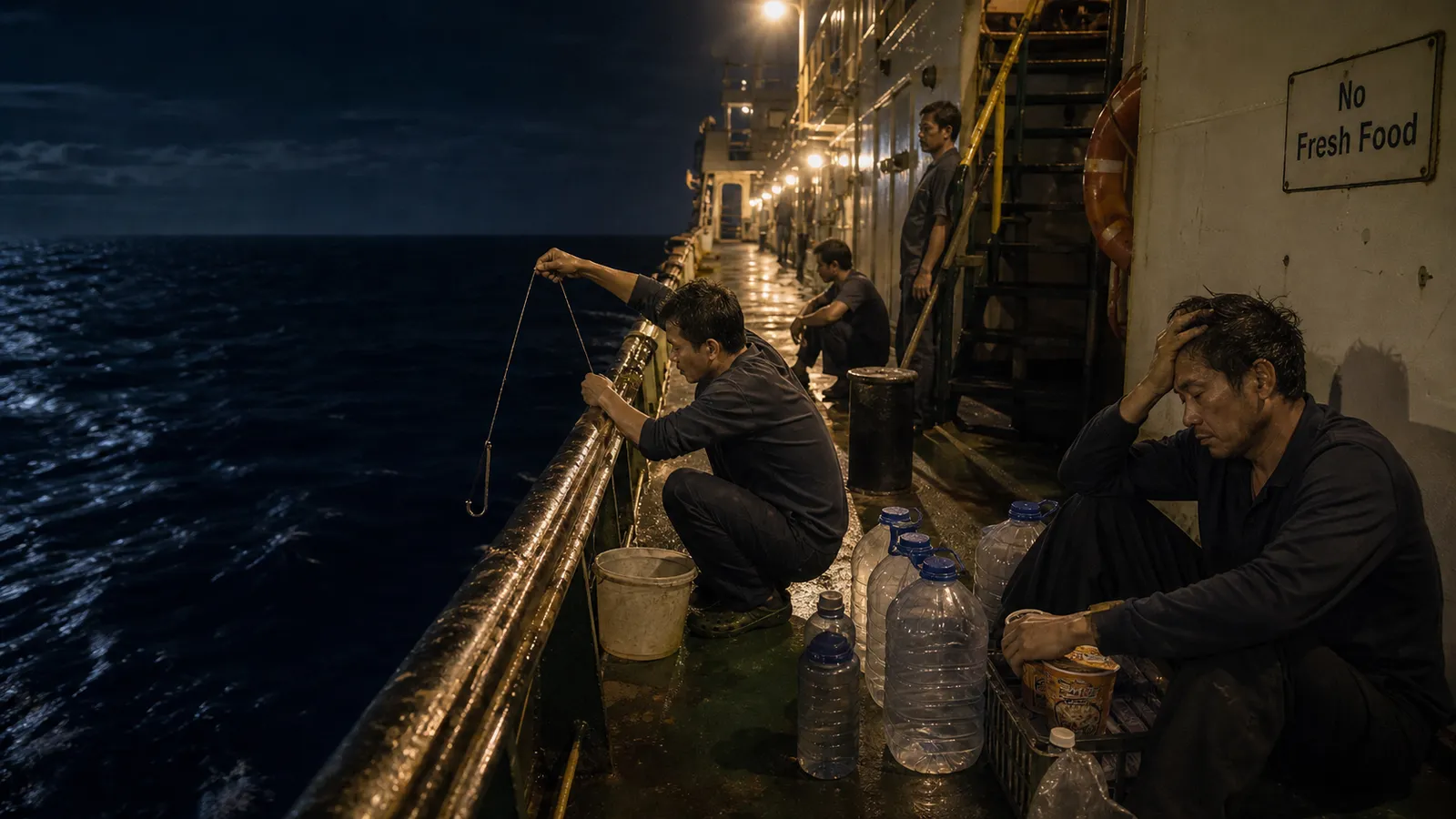
Crews trapped in the strait haven’t been to port in over 2 months.
Not because they don’t want to — because they can’t. Gulf littoral states, citing security, refuse entry to any stranded merchant vessel. Ships float mid-strait, living without fresh water, vegetables, fruit. Crews fish off the rails every day — not for entertainment, for supply.
The worst isn’t the lack of food and water. It’s hope.
The strait opens, closes, opens again. Every U.S. escort announcement, every Iranian “you may transit” signal, crews think they’re going home. Within 48 hours another ship gets seized, warning-shot, machine-gunned. Hope and despair oscillating — more destructive than plain despair.
On April 19, when the U.S. destroyer used 5-inch guns to fire warning shots at an Iranian container ship then boarded and took control, crews on ships dozens of nautical miles away could hear the gunfire. Three days later, the IRGC strafed the bridge glass of an MSC container ship with machine-gun fire.
After the war ends, crews won’t line up to sign on for Middle East routes. Shipowners will have to rebuild crews — hazard pay, insurance clauses, exit clauses. Industry convention says that process takes months.
Death Spiral
Global refining is running a textbook positive-feedback loop:
Crude rises → refining margins compress → refiners cut throughput → product supply falls → product inventory draws → product prices rise → refining margins recover → throughput rises → crude demand rises again → crude rises further.
This isn’t a prediction. It’s happening. Over the past few weeks, Singapore bunker fuel oil has run from $486/ton pre-war to $1,034; Fujairah from $476 to $1,248. Up 113% to 162%, no throttle. Singapore gasoil has run from $669 to $1,811. No matter how the latest refineries tune their product slate, they can’t keep up.
The loop runs until something breaks first — refineries shut down, governments cap prices, or demand finally craters.
The market’s last article of faith: “at some price, demand destroys itself.”
Not wrong, but the sequence is wrong.
Demand destruction isn’t “oil breaks $100, next day demand collapses.” It has to walk through a painful transmission chain first: gasoline hits $5/gallon → voters fume but keep driving → service-sector costs rise → small businesses fail → unemployment rises → only then does oil demand fall. This process takes at minimum 6–12 months.
And by the time demand actually cracks, the wells have long since been permanently abandoned. Both sides of the equation gone.
This is the actual meaning of “price destroys demand” — by the time demand is truly destroyed, the economy already is too.
Let’s Come Back to Reality
Everything above was built on the impossible assumption that “the war ends tomorrow.” Even in that impossible optimistic scenario, crude runs high for 5–8 months before it comes down.
But the war isn’t ending tomorrow. The first four essays covered why.
Now let’s come back to reality and look at what the back of the curve isn’t pricing.
Permanent Loss of Middle East Capacity
Jared Cohen, President of Global Affairs at Goldman Sachs, said the bluntest thing any analyst has said in an interview:
“Hormuz is never going back to what it was before the war.”
This is the first time Wall Street has publicly conceded — the world where 20 million barrels of crude flowed through Hormuz smoothly every day is not coming back.
IEA director Birol put it more directly in early April: “We’ve lost 12 million barrels/day of supply — more than the two major oil crises combined.” The “two crises” he means: the 1973 Arab oil embargo plus the 1979 Iranian Revolution.
This crisis has already surpassed every prior one in magnitude. The key difference: supply came back in both prior crises. This time it won’t.
Permanent Toll Regime
Iran’s parliament has legislated: Hormuz transit toll of $1 per barrel, meaning a fully loaded VLCC pays over $2 million. Collection began in April. Nine countries have already signed bilateral transit agreements. Settlement is in Bitcoin. This is a running commercial system generating $15 billion/year in net cash flow.
Any “war-ends” scenario requires Iran to give up this system — and this system is exactly the war trophy Iran cannot give up. Like asking Egypt when it gives up Suez Canal tolls. The answer is never. (Essay 2 argues this in detail.)
What’s Suez’s transit efficiency? 70–80 ships/day against a theoretical max of ~120. About 60–65%. And Suez has neutral management, standard piloting, global insurance coverage, and USD settlement — every condition is in place.
Hormuz’s toll regime? IRGC escort, Bitcoin settlement, friend-or-foe tiering (ships with U.S./Israeli links outright banned), single channel (south side declared mined). Every parameter is worse than Suez. Efficiency will be strictly below 60%.
My base case: 35%.
What that means: pre-war 20M bpd through Hormuz × 35% efficiency = only 7M bpd can get through. Add in bypass pipeline capacity (the main Saudi line plus the UAE sub-line) short-term covering maybe 4.5M bpd, and the world is still short 5–6M bpd every day.
Why North American Oil Stocks
Because North American oil stocks are one of the best expressions of the stagflation era.
Stagflation is the base case — oil sustained above $100 → sticky inflation → Fed can’t cut → growth slows while inflation doesn’t = stagflation. This isn’t a tail risk. It’s happening.
Why do oil stocks hedge stagflation?
For every $1 oil rises, North American oil companies capture $1 more per barrel in profit. Costs barely move — drilling, labor, equipment for shale are all domestic, but the sell price is the global benchmark. Straight addition on the income statement.
I don’t want to recommend specific names, but the screening criteria are hard:
Zero Middle East exposure. Any company with oilfield or refinery assets in Saudi, UAE, Iraq, or Qatar — you have to discount the book value. War risk isn’t priced.
Pipeline oil or North American domestic oil. Canadian oil sands (no marine transport, zero Hormuz dependency), U.S. shale, Canadian heavy conventional. These are “white oil” — a separate book from global seaborne crude.
Ample free cash flow, capex discipline, high dividends, low leverage. Multiple expansion is slow in stagflation, but dividends and buybacks land every quarter.
This isn’t a get-rich-quick short trade. In the short term, every peace headline prints a red candle — Trump tweets “I’m ready to leave” and oil stocks drop 5%. Every time the market trades peace, it’s a potential buying opportunity. Because the market eventually has to walk from fantasy back to reality.
The market is pricing this war in units of “months.” The correct unit is “years.”
When the market finally figures out that oil doesn’t return below $80 — maybe a refinery shutdown, a regional gas station running dry, or the day an OPEC increase is discovered to be “physically impossible” — North American oil stocks re-rate on both revenue and multiple at the same time.
Not one shot, possibly in waves. But the direction is one-way.
That’s why in an environment where everything is going to be more expensive, I think every ordinary person’s portfolio should have a position in oil stocks. In stagflation, sitting on cash long-term is guaranteed depreciation.
This isn’t a bet on war. It’s a bet on something more fundamental: permanent loss of supply must be permanently compensated in price.
After wrapping up four essays on the U.S.–Iran series, I want to pull the lens back from “how does this war end” to “what kind of world do we live in afterward.” Haven’t decided the next essay yet — two candidates: gold, or AI and what it does to humanity. Which one do you want? Tell me in the comments.
If you find factual errors or logical holes in my analysis, call them out in the comments. Let’s push this thought experiment as far as it’ll go.