U.S.–Iran Endgame · Episode 4
Summer Retreat: The U.S.–Iran Endgame
Wall Street priced this war with TACO — Trump Always Chickens Out. The market is right, Trump will TACO again. But this time, he can't spin his way out.
Right now, U.S. equities are partying. NASDAQ is at all-time highs.
Meanwhile: Hormuz is down to 7 ships a day (pre-war: 140), oil is stuck above $100, and U.S. carriers are out in the Gulf of Oman doing the job of Somali pirates.
These two things happening at the same time isn’t a contradiction. Wall Street gave this war a framing early: TACO — Trump Always Chickens Out. Trade war, Russia–Ukraine, Greenland — buy the dip is now market muscle memory. On this war alone, he has already threatened and backed down seven times.
The market is right: Trump will TACO again.
But the market is wrong about one thing: the first seven times, Trump could wave his hand, say “greatest deal,” and the scene closes. This time he can’t spin it. Because his off-ramp is gone.
This is the fourth and final essay in my U.S.–Iran series. The first three broke down “can’t fight,” “can’t settle,” and “Iran wins the blockade war.” This one answers the last question: how does this war actually end?
Three calls up front:
- The U.S. declares “victory” and withdraws this summer, with no deal.
- Iran gets permanent toll rights on Hormuz and keeps the nuclear program running.
- The GCC is forced to sign bilateral agreements with Iran. U.S. unipolar dominance in the Middle East — 40 years of it — ends.
The derivation isn’t complicated. Trump doesn’t choose to leave. He’s forced out. So this essay answers two questions:
- Why isn’t he leaving now?
- Why will he leave this summer?
Trump’s Illusion
Given everything the first three essays laid out, Trump’s most rational move right now is to declare victory immediately and withdraw — let Hormuz settle into the toll-regime equilibrium it’s going to reach anyway, contain the damage to the global economy and to the U.S. itself.
He won’t do it.
His Truth Social posts have laid out his current mental model in full:
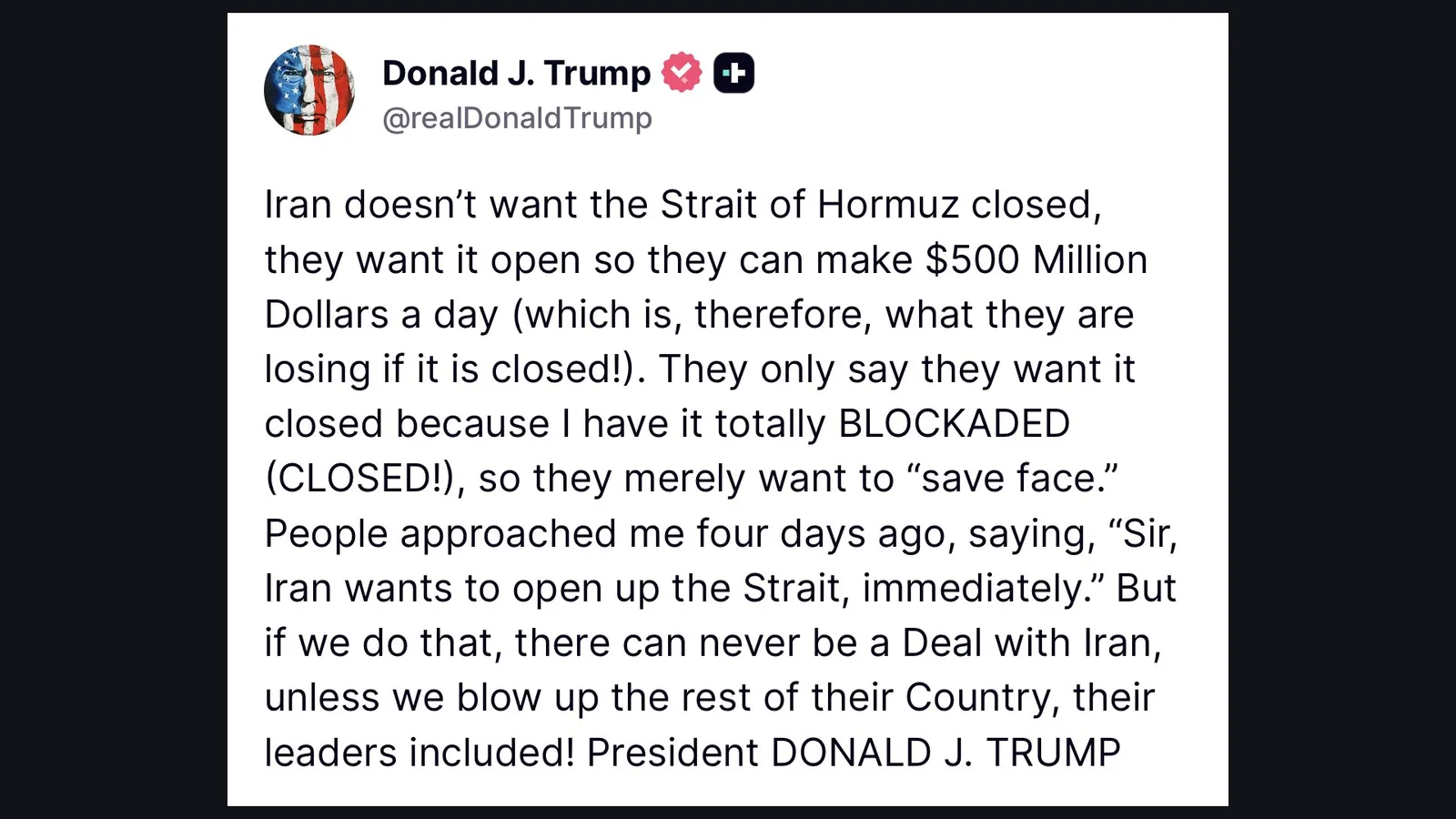
Three misreads:
1. He thinks Iran closed the strait for money. The “$500 million a day” in his posts shows he sees Hormuz as a business. But essay 2 already unpacked this — Iran doesn’t want money, Iran wants regime security. Strait control and nukes are survival tools, not commodities for sale.
2. His advisors are telling him “one more push and Iran cracks.” Storage nearly full, economy buckling, internal factions fighting — all of that might be factually true, but the conclusion is wrong. Essay 3 did the math: Iran has 6–7 months of buffer and can throttle production methodically — no abrupt shut-in. And the regime already passed its extreme stress test in February when the entire senior leadership was decapitated and a million protesters were on the streets. If it was going to collapse, it would have collapsed then.
3. He thinks the blockade is the last lever he has left, so he absolutely cannot let go. This is the most dangerous belief — because it creates a self-reinforcing “one more push” loop.
“Just one more push” is the most expensive four words in U.S. foreign policy history. Vietnam — “one more bombing round and Hanoi folds” — went on for 7 years. Trump’s own tariff war — “one more round and China caves” — ended with China fine and U.S. equities cracking first. Every “one more push” underprices the cost and raises the exit bar. We’ve already put in so much, giving up now wastes all of it, right?
Trump is stuck right here. Not because he doesn’t want to leave — because he can’t. Sunk cost + bad advisor intel + fundamental misread of Iranian motives. Three interlocking loops, all locked.
And this TACO costs more than any previous one. The tariff war he can spin as “I signed a great deal.” Russia–Ukraine peace talks that died quietly, people eventually stopped asking. Iran is different. Withdrawing means de facto accepting Iran’s permanent control of Hormuz and de facto accepting Iran’s nuclear program — total failure on both core strategic objectives of the war. No rhetoric can repackage this as victory. This isn’t “didn’t win.” This is “lost” — and the whole world can see it.
The political cost of exit is enormous. So he stays inside the illusion that he can still win — until some external force decides for him.
So what breaks the stalemate?
Not Trump changing his mind. Something else snapping first. Below are the four forces I believe will push Trump out this summer.
World’s Most Expensive Pirates
Start with the cost of the blockade itself.
Iran’s cost to block Hormuz is close to zero — the strait is on its doorstep, 33 km wide, a few warning shots and every merchant ship reroutes itself. Barely needs patrolling. The U.S. blockade line sits outside the Gulf of Oman, covers nearly 300 km, needs 24/7 monitoring.
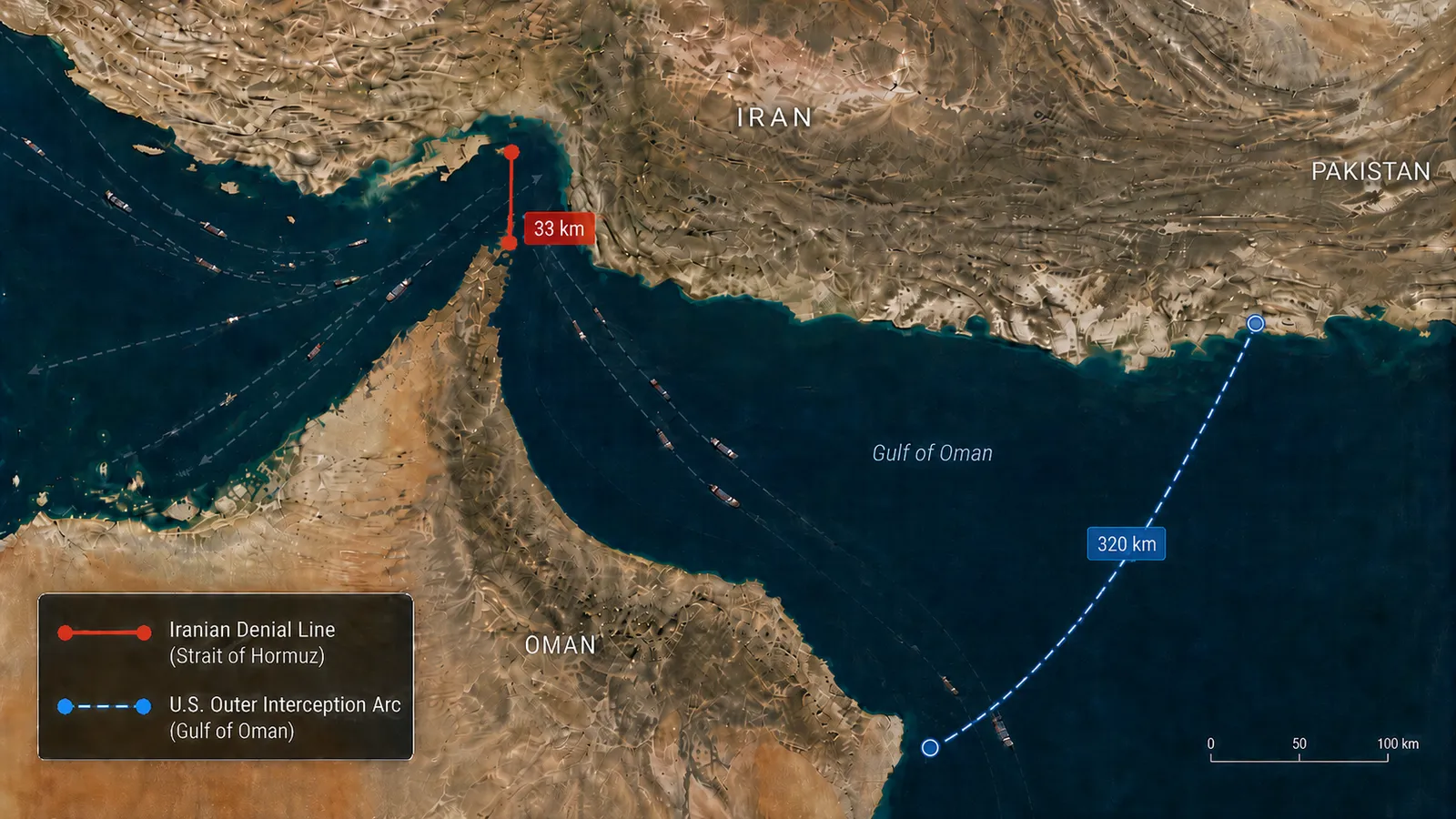
Picture it: Somali pirates hijack merchant ships with speedboats and AK-47s. The U.S. is doing the same job — with aircraft carriers.
The U.S. Navy also faces a rarely-discussed logistics problem. Pre-war, the Persian Gulf was the Navy’s “giant gas station” — Bahrain, Dubai, Fujairah, Muscat, fuel everywhere. Now every one of those ports sits inside Iran’s 5-minute ballistic envelope. Not safe. Fleet replenishment distance has stretched from tens of miles to over a thousand. Diego Garcia has become the core forward base. Tankers now depart from Singapore, Australia, even Japan and Korea, handing fuel across the ocean in relay to warships.
Military resupply and commercial shipping are now fighting for the same scarce resources: qualified tankers, crews, clean fuel, port slots. Every tanker the military locks up is one fewer tanker moving commercial oil.
This isn’t hypothetical. U.S. munitions burn rates tell the story: total war spend $28–35B, the first two days alone burned $5.6B in ordnance. Tomahawk inventory has dropped from 4,000 to 3,000. Annual production is 100 units. At that rate, replenishment takes 30 years.
The blockade is the only affordable pressure tool left after the munitions ran out. “Affordable” — relative to bombs. In absolute terms the cost is still staggering. As summer arrives and Peninsula temperatures hit 45°C, carrier deck wet-bulb temperatures can exceed 50°C. The Navy running carriers in those conditions to do Somali-pirate work — execution degrades, dark-fleet breakthrough rates rise, the blockade erodes into something nominal.
Iran just waits.
Financial Pressure Cooker
This is the force most likely to force Trump out. Also the hardest for a general audience to understand. I’ll try to keep it clean.
The logic chain is one sentence: high oil → high inflation → high rates → debt explosion.
The U.S. has $42 trillion+ in federal debt outstanding. The 30-year yield has touched 4.98% — 2 basis points from 5.0%, the line Wall Street treats as a structural break.
Why is 5.0% the live wire? Because at that level, multiple time bombs detonate simultaneously:
Bomb 1: Basis Trade. A hedge fund strategy that uses 50–100x leverage to capture the tiny spread between cash Treasuries and Treasury futures. If the 30-year breaks 5%, spread volatility gets large enough to trigger margin calls — and then it’s March 2020 all over again: everyone dumps Treasuries at once → yields spike further → more margin calls → death spiral.
Bomb 2: The Yen. USD/JPY has already cracked 160 (the BOJ had to intervene this week to pull it back). The mechanic is simple: oil up → Japan needs more dollars to pay for oil → Japan sells yen for dollars → yen weakens. Weaker yen makes short-yen carry trades more profitable, which attracts more capital, which self-reinforces. If the loop goes out of control, Japan may be forced to dump Treasuries to defend the yen — and Japan is the largest foreign holder of U.S. debt. Japan selling Treasuries = U.S. yields spike involuntarily = Basis Trade blows up = financial accident.
Bomb 3: Commercial Real Estate and Private Credit. In a high-rate environment, piles of CRE loans can’t refinance, and private credit funds’ underlying assets start defaulting. These are slow poisons — they don’t detonate overnight, but at some point they become the straw that breaks the camel’s back.
Three bombs share one fuse: oil. As long as the Hormuz blockade persists, oil stays above $100, inflation doesn’t come down, rates can’t come down, and the fuse burns shorter every day.
The Fed is now in a bind: don’t hike, inflation keeps rising; hike, and the 30-year blows through 5% — detonating every bomb above. Both roads arrive at the same destination — the only difference is whether we hit 5% in one step or grind our way there.
And the source of it all is the double-blockade at Hormuz.
The World Starts Going Hungry
This is a delay-fuse bomb — you don’t feel it now, but the seed is planted.
Hormuz doesn’t just carry oil — it also carries 30–35% of global seaborne fertilizer trade. Urea, ammonia, sulfur — all cut off. Worse, Qatar’s QAFCO lost two fertilizer production lines to Iranian missile strikes (3–5 year rebuild). China has simultaneously restricted fertilizer exports through August.
Fertilizer and oil differ in one critical way: expensive oil means you drive less. Missing fertilizer means you can’t farm less. You can’t skip a season of nitrogen application — miss it, lose the whole season’s yield.
The fertilizer shortage transmits to food prices with a 6–9 month lag. The war broke out at end of February, fertilizer supply started disrupting in March. On that timeline, the food price shock reaches global tables this August–October.
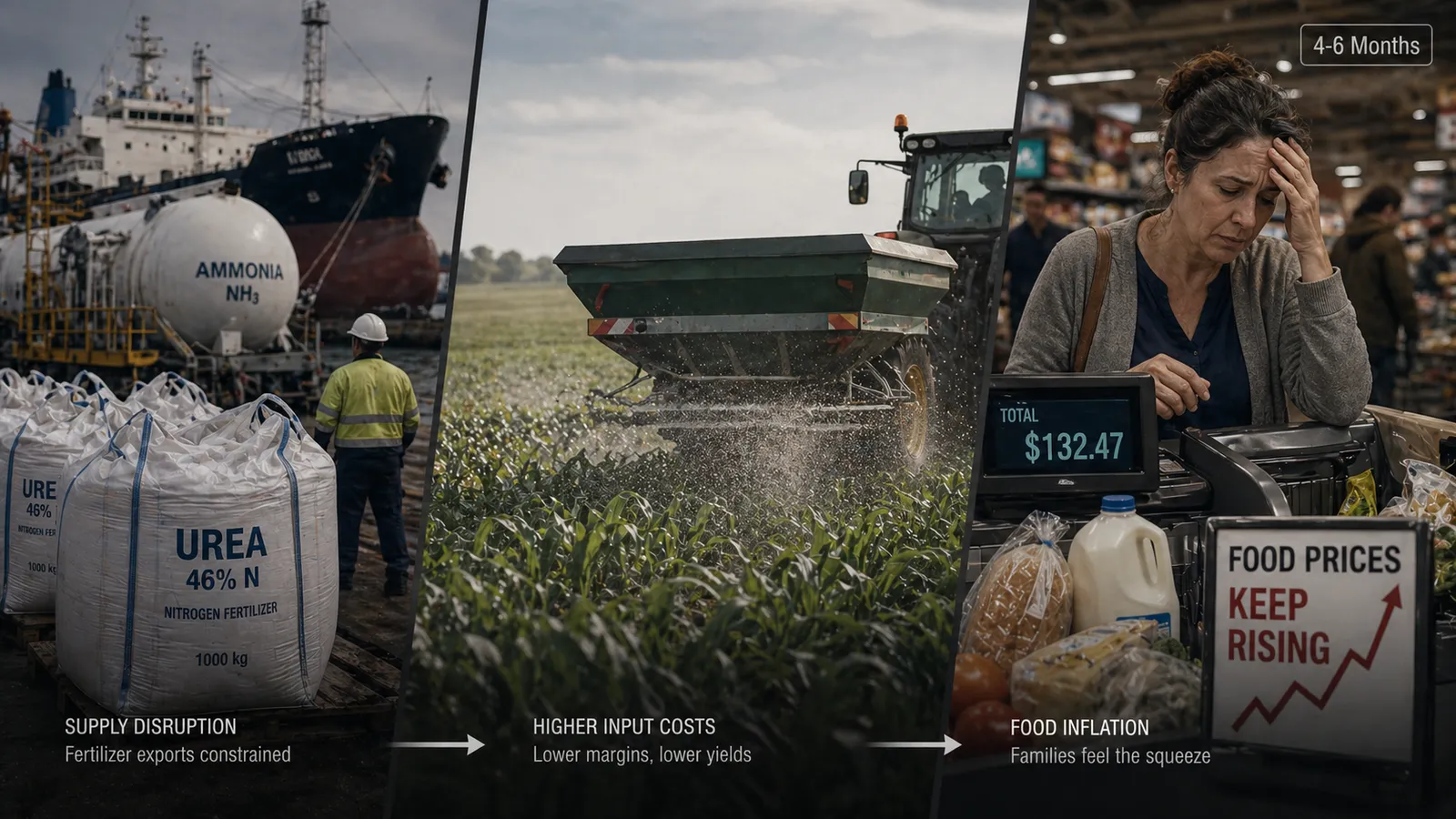
The picture then: food crises in developing countries, supermarket price spikes in developed ones. And the whole world knows — Iran offered to reopen Hormuz (with tolls), and the U.S. refused. When famine footage starts coming out of Africa and Southeast Asia, “the U.S. blockade caused global hunger” goes viral fast. Voters hit the streets again.
Gas Price = Vote Price
The most direct force: the price at the pump.
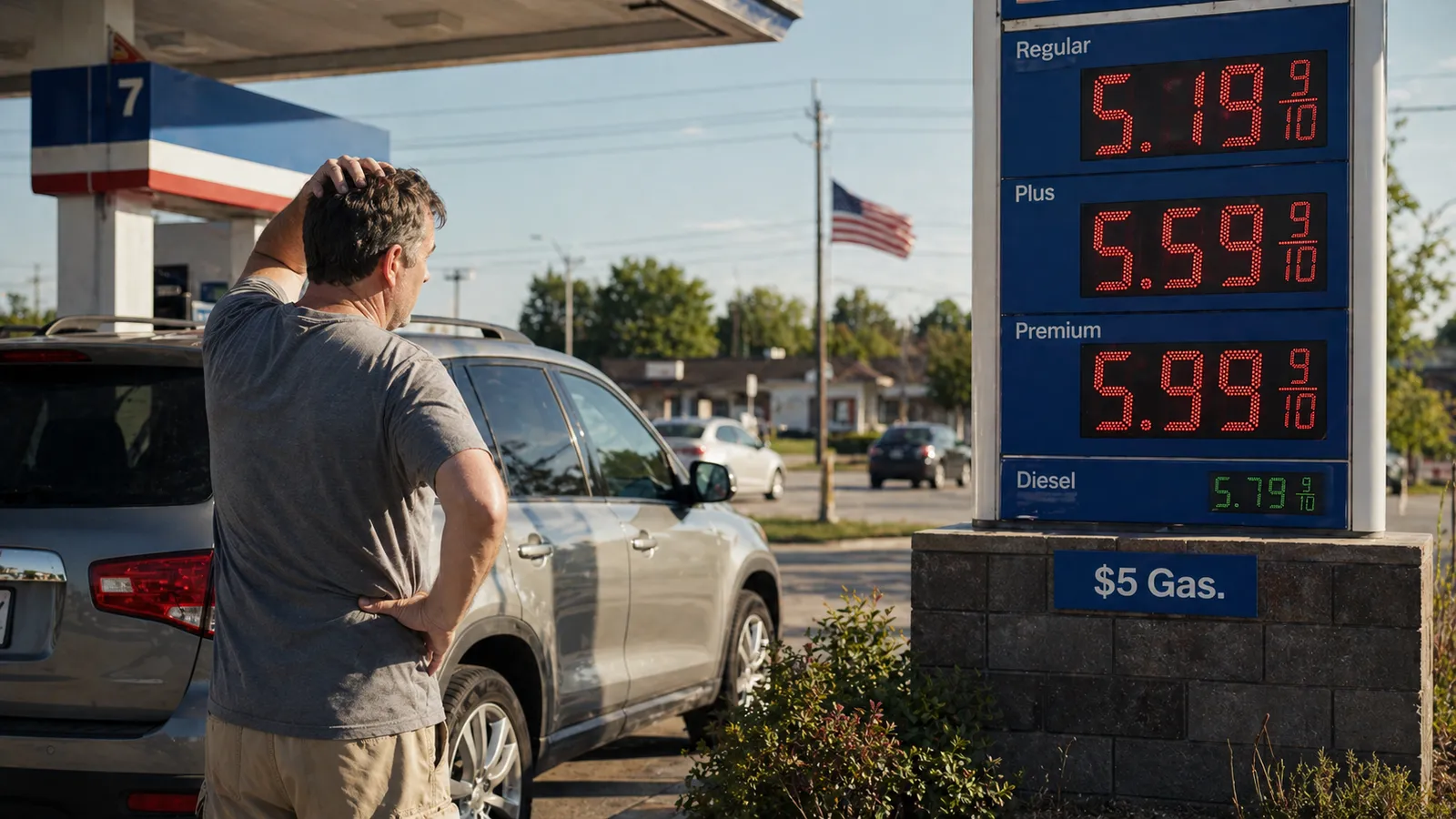
U.S. average gasoline is around $4.3. Painful, but voters can still absorb it. Historically, $5 is the psychological threshold — when gas broke $5 in 2022, Biden’s approval dropped to 38%.
If the double blockade drags into June — exactly when U.S. summer driving season opens — gasoline demand surges seasonally, on top of crude inventories drawing down at 3–4x expected pace (last week’s EIA data: 6.2 million barrel draw, far above consensus). $5 becomes near-certain.
Once $5 breaks, political pressure propagates fast. November 2026 is the midterms — Republican senate candidates will start peeling off from the blockade policy publicly, calling for “ending this no-winners war of attrition.” When his own party starts fleeing, Trump knows time’s up.
Trump’s behavioral pattern is predictable: every fracture signal triggers first a blame round — Iran, China, the Fed, Biden — then another raise. Then a larger fracture signal, another blame round, another raise. The loop continues until the fracture gets bigger than his narrative engine can digest. That’s the exit moment.
30-year breaks 5%. Gas breaks $5. A financial institution blows up. Global food crisis hits the headlines. These events don’t all need to fire simultaneously. Any two or three in combination is enough to overwhelm Trump’s narrative capacity.
After the Endgame
So the full logic chain of the four essays closes:
- The U.S. can’t escalate (military dead end).
- No deal is possible (game structure locks it).
- Iran wins the blockade war (47-year-sanction immune system).
- The U.S. is forced out this summer (four forces tightening in parallel).
What does the world look like after the exit?
I’m not optimistic. On this framework, by the time Trump is finally forced to declare “mission accomplished” and walk away quietly — the damage has already happened.
Oil ran above $100 for months. Inflation is ugly. The 30-year hovers near 5%, some hedge funds or regional banks have already blown up. The yen has been through one or more violent cycles. The fertilizer shortage is hitting food production.
And Iran? Iran walks away with $15B/year in permanent Hormuz tolls, a nuclear program still advancing with zero oversight, and the narrative halo of “defeated the United States.” It enters a new Middle Eastern order — where the GCC deals directly with this new regional power, no longer routed through Washington.
U.S. unipolar dominance in the Middle East — 40 years of it — ended by a war it started itself.
Ironic? Deeply ironic.
Four essays done. Thanks to everyone who made it all the way here.
This entire analytical framework didn’t come out of me alone — it came from weeks of deep conversation and adversarial modeling with AI. I won’t pretend to be a Middle East expert. But I do believe that a strong framework plus powerful reasoning tools lets an ordinary person see things that experts sometimes miss.
If you find any factual errors or logical holes across the four essays, please call them out. This isn’t a polite disclaimer — analysis only gets sharper under adversarial challenge.
Let’s push this thought experiment as far as it’ll go.